
Polarization measurements of solar radio emissions are key diagnostics of coronal plasma, magnetic fields, and propagation effects, and can provide additional constraints on the emission mechanisms. At meter wavelengths, circular polarization (CP) has long been exploited in solar radio studies, while linear polarization (LP) has been assumed to be absent. This view arose from the expectations that strong coronal Faraday rotation would completely depolarize LP within typical observational bandwidths and instrumental angular resolution (Grognard & McLean 1973; Boischot & Lecacheux 1975).
Consequently, the presence of LP in uncalibrated datasets was routinely attributed entirely to instrumental polarization leakage and, in many cases, used to impose a calibration constraint that LP must be zero. Here we report the first unambiguous detection of intrinsic LP at metric wavelengths. To rule out any potential instrumental systematics and analysis artefacts, these observations were carried out simultaneously using two independent telescopes – the Murchison Widefield Array (MWA) in Australia and the upgraded Giant Metrewave Radio Telescope (uGMRT) in India – which differ fundamentally in design (MWA: aperture array, linear feeds; uGMRT: dish array, circular feeds) and are geographically separated by thousands of kilometers.
Observations and Results
On 2022 June 25, simultaneous observations were carried out using the MWA and the uGMRT covering the 217–247 MHz frequency range. Both telescopes detected LP from two spatially separated sources associated with two type I noise storms, and from a short-lived type III burst. The detections are consistent across the two instruments,
At 218 MHz (Figure 1):
- The brighter west-limb source exhibited LP fractions of about 6% (MWA: 6.0 ± 0.3%; uGMRT: 5.9 ± 0.5%).
- The fainter east-limb source showed stronger LP, about 13% (MWA: 13.5 ± 0.5%; uGMRT: 12.3 ± 2.0%).
The LP fraction also showed rapid variability: in the east-limb source, it ranged from ~2% to ~31% over short time–frequency intervals. During a type III burst at 04:14:14 UTC, the LP fraction dropped sharply from >10% to <5% within one second over 217–220 MHz.
The morphological evolution of the Stokes parameters further reinforces the solar origin of LP. During the type III burst, Stokes Q reversed sign, Stokes U elongated, and Stokes V evolved from a monopolar structure into a bipolar structure, while Stokes I remained comparatively stable morphologically (Figure 2). Such independent evolution across Q, U, and V cannot be explained by instrumental leakage from Stokes I.
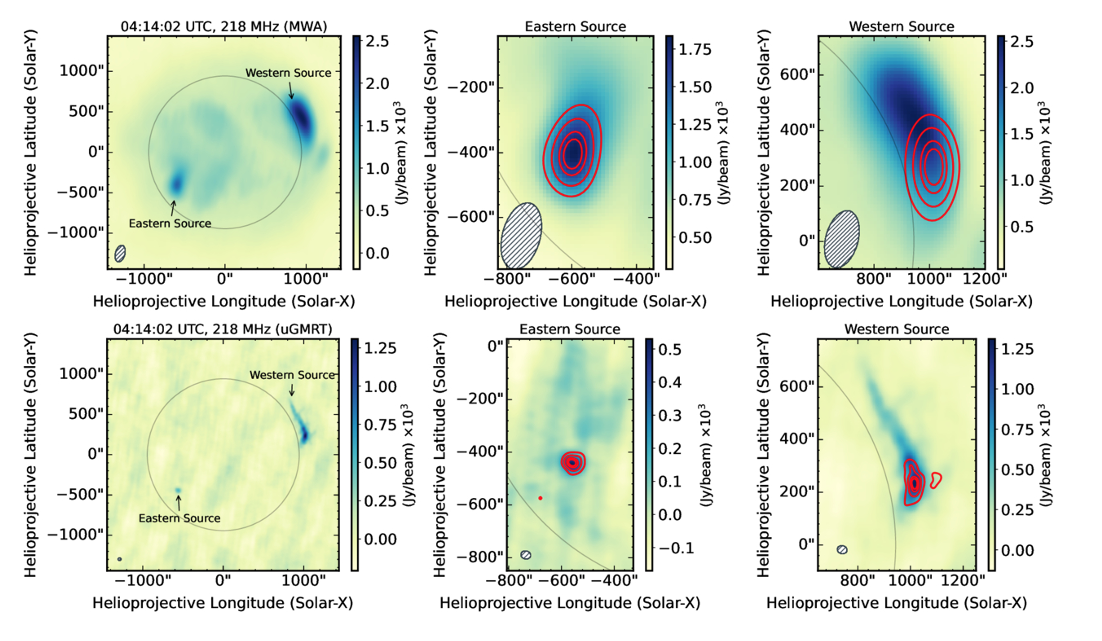
Figure 1. Simultaneous detection of linearly polarized emission at 218 MHz with the MWA (top panels) and uGMRT (bottom panels). The left panels show the full-disk field of view with two bright limb sources marked; the middle and right panels provide zoomed-in views. Red contours denote linear polarization intensity at 0.4, 0.6, 0.8, and 0.9 of the peak, and the black circles mark the optical solar disk. Both sources exhibit partial linear polarization. The eastern source, weaker in Stokes I, shows higher LP fractions of 13.5 ± 0.5% (MWA) and 12.3 ± 2.0% (uGMRT), while the brighter western source shows lower LP: 6.0 ± 0.3% (MWA) and 5.9 ± 0.5% (uGMRT).
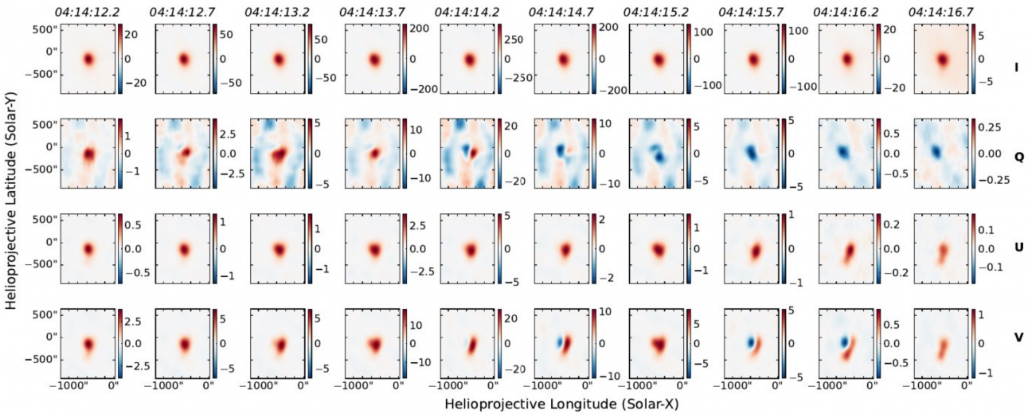
Figure 2. Temporal evolution of polarization maps at 220 MHz for the eastern source during a type III burst. The four rows show Stokes I (total intensity), Q, U, and V, each in units of kJy/beam. The maps display uncorrelated morphologies across the Stokes parameters. At 04:14:14.2 UTC, Stokes Q reverses sign while Stokes U becomes elongated—clear evidence that these polarization features are intrinsic to the solar emission and not due to instrumental leakage.
Discussion
These observations provide definitive evidence that LP at meter wavelengths can indeed be observed during active solar emissions. This directly challenges the long-held assumption of complete depolarization of LP due to Faraday rotation.
The persistence and observed variability of LP require re-examining the role of coronal propagation effects. Two plausible origins in this case are:
- Mode coupling in quasi-transverse regions provides a natural mechanism to generate partial LP from plasma emission (Zheleznyakov & Zaitsev 1970; Melrose 1974).
- Reflection at the boundaries of plasma density contrasts may also produce LP (Bastian et al. 2022), though the rapid time–frequency variability of Stokes Q and U observed here disfavors this as the dominant mechanism.
The implications of this work extend beyond the Sun. The presence of LP has often been treated as a reference in support of the evidence against plasma emission and in favour of electron cyclotron maser processes in coherent stellar bursts (Lynch et al. 2017; Callingham et al. 2021). This is guided by the traditional consensus of the non-existence of linear polarization from solar radio emissions, which are dominantly plasma emissions.
Conclusions
We report the first robust detection of linear polarization in solar metric emissions, with independent confirmation from two widely separated radio interferometers of very different designs. These detections demonstrate that LP is of solar origin, persists despite depolarization expected from coronal propagation, and displays rich temporal and spectral structure.
This work leads to the following key implications:
- The presence of LP in active solar emissions cannot be ignored. Calibration schemes that assume zero LP also bias the estimation of CP.
- LP provides a new probe of the corona and propagation effects, providing an opportunity to improve our understanding of the coronal magnetic fields and propagation.
Based on recent paper by Soham Dey, Devojyoti Kansabanik, Divya Oberoi and Surajit Mondal, “First Robust Detection of Linear Polarization from Metric Solar Emissions: Challenging Established Paradigms”, 2025 ApjL, 988, L73
References
Bastian, T. S., Cotton, W. D., & Hallinan, G. 2022, ApJ, 935, 99
Boischot, A., & Lecacheux, A. 1975, A&A, 40, 55
Callingham, J. R., Pope, B. J. S., Feinstein, A. D., et al. 2021, A&A, 648, A13
Grognard, R., & McLean, D. 1973, SoPh, 29, 149
Lynch, C. R., Lenc, E., Kaplan, D. L., Murphy, T., & Anderson, G. E. 2017,
Melrose, D. 1974, AuJPh, 27, 31
Zheleznyakov, V. V., & Zaitsev, V. V. 1970, SvA, 14, 47