
Type-II radio bursts are usually observed below 400 MHz with slowly-drifting narrow fundamental and/or harmonic bands. Events with starting frequencies higher than 400 MHz are rarely reported (e.g., Pohjolainen et al. 2008). Such high-frequency Type-IIs may stem from the CME interaction with surrounding dense structures in the corona, such as streamers, ray-like or loop structure, or from sources in the lower corona.
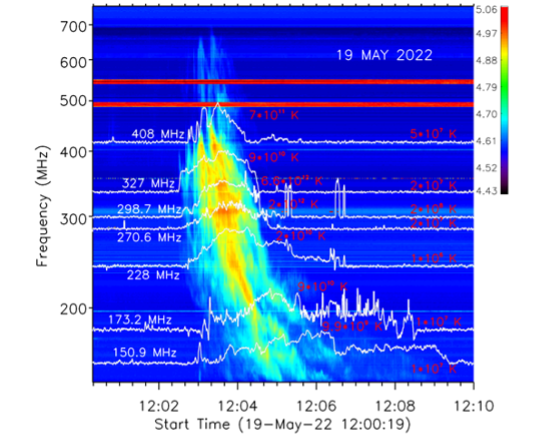
Figure. 1. Dynamic spectrum of the high-frequency wide-band type-II burst recorded by the ORFEES radio spectrograph (670 – 144 MHz). The maximum brightness temperatures (TBmax) at different NRH frequencies are plotted with white lines.
Here we report an unusual wide-band high frequency type-II burst on 19 May 2022 with starting frequency as high as 670 MHz and an instantaneous bandwidth as wide as 300 MHz, as recorded by the ORFEES spectrograph (see Figure 1). Such bandwidth is much wider than usual events. In addition, at any specific frequency the burst lasts for 2 mins. This is also much longer than usual bursts. Simultaneous observations of extreme-ultraviolet (EUV) and radio imaging from the Nançay Radio Heliograph (NRH) are available for this event. This allows us to measure the location of radio sources over the EUV shock structure and to explore the cause of the high-frequency wide-band feature.
By over-plotting the 90 and 95% contours of TBmax onto the closest-in-time AIA 211 Å running difference images (see Figure 2), we made four observations: (1) the type-II sources are co-spatial with the nose front of the EUV shock wave structure (being slightly separated, by 0.01 Rʘ; (2) the sources basically overlap with each other before 12:04 UT (without spatial separation 0.001 Rʘ; later they become spatially dispersed, with lower-frequency sources being farther away from the disk; (3) as already mentioned, the sources at several frequencies appear simultaneously, and they distribute within a broad region of 150 ̶ 200 arcsecs; and (4) during most time of the burst, the sources are spatially dispersed yet still centered around the dip of the shock front that corresponds to the CME-shock transit across the bright dense loop tops.
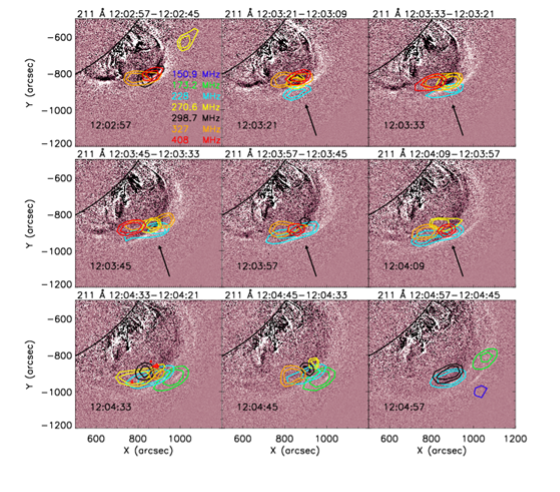
Figure 2. Temporal evolution of NRH sources superposed onto the closest-in-time AIA 211 Å images. The radio sources are represented by the 90% and 95% of TBmax contours.
The dip is likely due to the strong compression caused by the shock propagation into bright and dense loops where the Alfvénic speed (as well as the shock speed) is relatively low. According to the EUV and white light data, bright and dense loops that connect the two spots are spatially correlated with the shock dip, indicating the shock has transited across them with a strong interaction. In this case, electron acceleration is quite efficient according to numerical simulations by Kong et al. (2015, 2016). We suggest that the type-II burst originates from the shock transit across these magnetically closed-loop structures that forms the shock dip (see Figure 3).
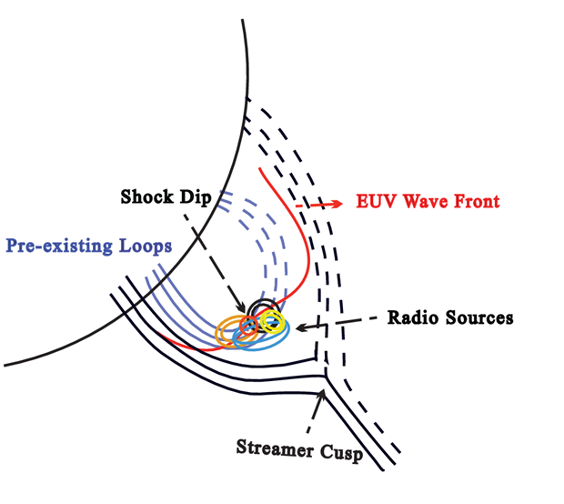
Figure 3. Sketch of the shock-loop system with the dip region and the corresponding type-II radio sources.
The wide-band feature of the type-II burst means that the sources stem from a region with a large range of density; either the density fluctuations of the source have large amplitudes or the source extends over a broad and highly inhomogeneous region. Our observations favor the latter scenario: that the wide-band type-II burst stems from the broad sources centered around the shock dip.
We suggest that the burst represents the harmonic branch, since the fundamental one experiences much-stronger scattering/absorption effect and for many other coronal bursts the harmonic branch often represents the stronger one. At 12:03:41 UT, the upper and lower frequencies of the burst are 440 and 180 MHz, respectively. Then, the densities within the type-II source at 12:03:41 UT should vary from ~109 to ~108 cm3, with a ratio of ~10. This is much larger than any possible compression ratio of a magnetohydrodynamic shock, indicating that the wide-band feature is not due to density variations across the shock layer. Further studies on similar events are necessary for a deeper understanding of their origin.
Based on a recently published article: V. Vasanth, Yao Chen and G. Micahlek, Awide-band high-frequency type-II solar radio burst, Astronomy & Astrophysics, 2025, 720, A15. DOI: 10.1051/0004-6361/202554430
References
Kong, X., Chen, Y., Guo, F., et al. 2015, ApJ, 798, 81
Kong, X., Chen, Y., Feng, S., et al. 2016, ApJ, 830, 37
Pohjolainen, S., Pomoell, J., & Vainio, R. 2008, A&A, 490, 357
*Full list of Authors: V. Vasanth, Yao Chen and G. Micahlek