
Solar flares are generally divided into two classes: eruptive flares (with associated coronal mass ejections; CMEs) and confined flares that lack CMEs. Because eruptive flares are the principal source of major space weather effects at Earth, relatively little attention was paid to confined flares until the great sunspot group of October 2014, designated NOAA 12192, passed across the solar disk giving rise to 35 large flares (29 “M” SXR-class and 6 “X” class), for which all but four (M-class) flares were confined. For context, approximately half of all M-class flares and ~90% of X-class flares have associated CMEs. The relative absence of eruptions in the large flares from 12192 has been attributed to magnetic suppression of eruptions by strong fields overlying the spot group (Chen et al. 2015). We find that microwave spectra can distinguish between confined and eruptive flares.
Analysis and Results
Our study was based on observations from the US Air Force’s Radio Solar Telescope Network (RSTN ) which monitors eight fixed frequencies (from 245 MHz to 15,400 MHz) at four locations spanning the globe. We did not consider the RSTN 245 MHz observations in our analysis because of frequent low-level noise-storm-type activity that was generally not a factor at the adjacent 410 MHz frequency.
The principal results of our analysis are depicted in Figure 1 that shows time-intensity profiles for the eight RSTN frequencies (top panel) and for Wind Waves observations at 1 MHz (middle panel) for two confined flares (a and b) and two eruptive flares (c and d). The peak fluxes in the spectrum plots for each event in the bottom panel are the largest values above background within ±2 minutes of the spectral peak in the 4995–15,400 MHz range. While confined flares typically have peak 410 MHz emission < 10 sfu above background, eruptive flares characteristically have peak 410 emission above this level. In Figure 2 we plot peak emission in the ~5-15 GHz range vs. peak 410 MHz emission for samples of 21 confined and 30 eruptive large (≥M5; new NOAA scaling (Hudson et al. 2025)) flares from Kazachenko (2017) for 2010-2016. In general, the dashed vertical line at 10 sfu separates the two populations. Several of the counter-examples are instructive as exceptions that support the rule. To first order, confined flares lack emission above background at 1 MHz while eruptive flares have strong emission at this frequency.
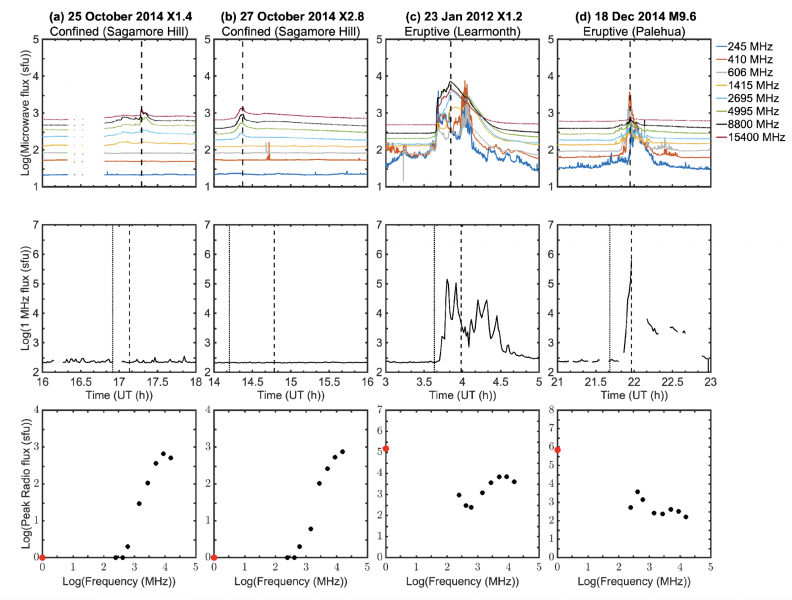
Figure 1. (Top panel for each event) Time profiles of flux density at the eight RSTN frequencies for two confined flares from NOAA AR 12192 (a and b) and two eruptive flares (c and d). (Middle) Time trace of Wind/Waves 1 MHz emission. (Bottom) 1–15,400 MHz peak flux radio spectra for each event, with the 1 MHz peak flux plotted in red on the y axis. The dashed lines indicate the time of peak ~5-15 GHz emission (top panel) and the onset and peak of 1–8 Å SXR emission (middle).
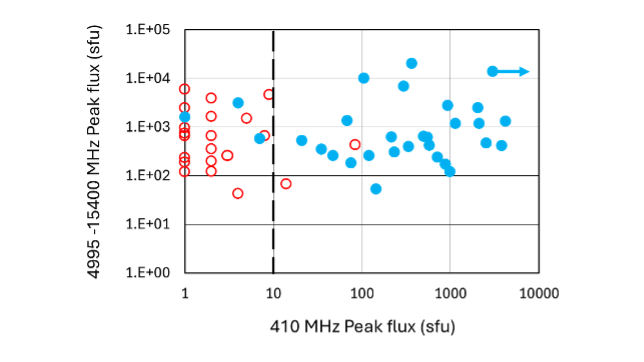
Figure 2. Scatter plot of the peak flux in the 4995–15,400 MHz range vs. the peak 410 MHz flux for samples of 21 confined (red data points) and 30 eruptive ≥M5 SXR flares (blue).
Conclusion: Interpretation and Applications
Because the plasma frequency at 1 MHz corresponds to a height of ~7 solar radii, the absence of such emission in confined flares implies a lack of open field lines and escaping flare-accelerated electrons. Thus the causative reconnection must be between closed magnetic loops, ruling out interchange reconnection between open and closed field lines for confined flares. The strong 1 MHz emission for the eruptive flares is attributed to shock acceleration on open fields surrounding the expanding CME.
The 410 MHz discriminator between eruptive and confined flares can be used for earlier periods (~1965-1995) with global radio coverage but no, or inadequate, coronagraph coverage. In addition, microwave spectra have potential application to distinguish between confined and eruptive stellar flares, with the Very Large Array observing band from 224 to 480 MHz well-suited for solar-type stars.
Based on a recent paper by Cliver, E.W., Kazachenko, M., Hudson, H.S., Alberti, T., Laurenza, M., White, S.M., & Gallagher, P.T. 2025, ApJ, 994, 103, DOI: 10.3847/1538-4357/adfbe5
References
Chen, H., Zhang, J., Ma, S., et al. 2015, ApJ, 808, L24. Doi: 10.1088/2041-8205/808/1/L24
Hudson, H., Cliver, E., White, S., et al. 2024, SoPh, 299, 39. Doi: 10.1007/s11207-024-02287-x
Kazachenko, M. D., Lynch, B. J., Welsch, B. T., & Sun, X. 2017, ApJ, 845, 49. Doi: 10.3847/1538-4357/aa7ed6