
Solar radio bursts (SRBs) are some of the most interesting signatures of solar activity. Their correlation with large solar eruptions and well-documented disruption to technological infrastructure especially highlights their relevance (Temmer 2021; Li et al. 2024; Liang et al. 2024). As the volume of radio data grows, it becomes increasingly important to ensure that there are reliable automated methods for the classification of SRBs, especially if these methods can contribute to real-time space weather monitoring. In our recent study, we explored whether modern machine-learning techniques, specifically transfer learning, could reliably address the classification of spectra containing Type II and Type III bursts.
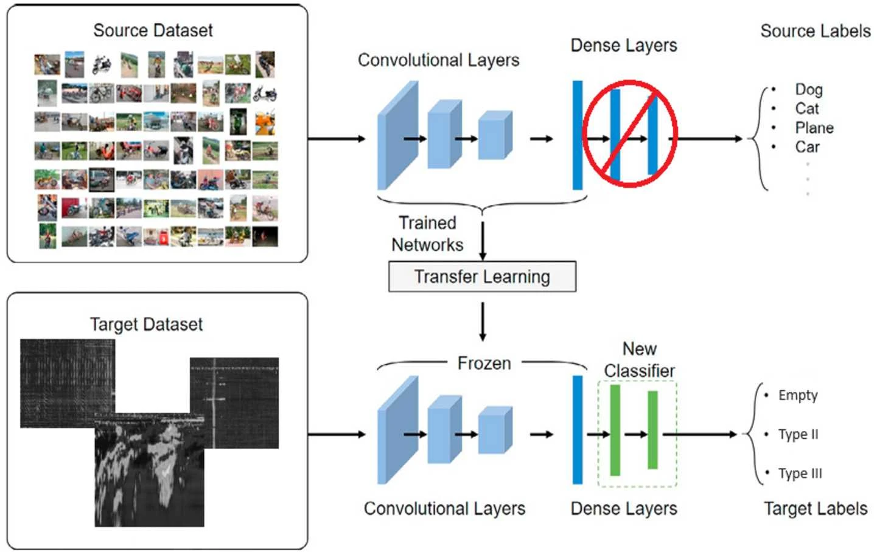
Figure 1. A diagram of the general architecture of transfer learning models, illustrating the frozen feature extraction layers and retrained dense layers, which have been adapted for this study (Tao et al. 2020).
Type II and Type III SRBs are among the most valuable signatures for studying solar activity and space weather. Type II bursts are typically associated with shock waves driven by powerful coronal mass ejections, whereas Type III bursts result from beams of fast electrons streaming along open magnetic field lines. These distinctive radio emissions can be detected by ground-based radio spectrometers worldwide. A dataset of observations was created using data collected from the e-Callisto network between January 2021 and April 2023. This dataset was labelled using event lists compiled by e-Callisto observers. Given the relative rarity of Type II bursts compared to Type III bursts, a stratified sampling approach was used to balance the dataset. Using the created dataset, we fine-tuned several deep-learning architectures, VGG-19, MobileNet, ResNet-152, DenseNet-201, and YOLOv8, each pre-trained on the ImageNet dataset. By reusing feature-extraction layers from these pre-trained models (see Figure 1), we can effectively transfer knowledge learned from large-scale natural image datasets to the domain of solar radio spectrograms, achieving high classification performance even with a relatively small and specialised training set.
These architectures achieved accuracies between 87% and 92% on an independent test set. Among them, YOLOv8 delivered the strongest overall performance, with an accuracy of 92% (see Figure 2) and balanced precision and recall across all three classes. One of the strengths of YOLO-based models is their ability to capture fine-scale patterns even in noisy spectra, which is especially valuable given the diverse observing conditions across the global e-Callisto network. Stations vary widely in noise environment, RFI levels, and spectral coverage, yet the model generalised well despite these differences. Nevertheless, the analysis of misclassified samples highlights remaining challenges. These suggest that both spectral noise and overlapping burst morphology remain limiting factors, and that additional training samples, particularly for Type II events, would likely improve model robustness.
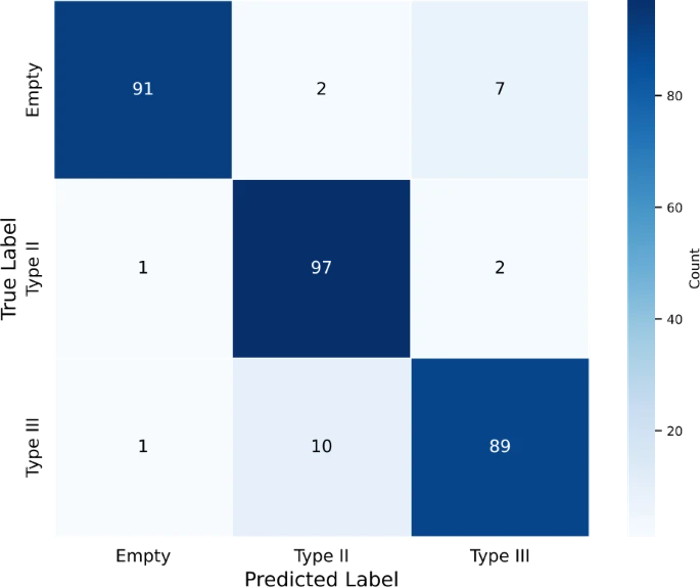
Figure 2. Confusion matrix illustrating the distribution of classifications made by the best performing (YOLOv8) model. Values represent raw counts of predictions for each class (Empty, Type II and Type III), with rows as true labels and columns as predicted labels made by the model.
Conclusion
This study demonstrates that transfer-learning techniques offer a practical and highly effective path toward automated SRB classification, despite the small number of samples. The strong performance of YOLOv8 shows particular promise for future applications, including real-time burst monitoring and automated event catalogues. Continued progress will come from expanding the dataset, utilising physical augmentation strategies, and exploring ensemble approaches that combine multiple architectures. The use of segmentation techniques could allow for the extraction of physical parameters from SRB events. These parameters can aid in researching the morphology of SRBs.
Based on a recent paper by Le Roux, H., Steyn, R., Strauss, D.T. et al. Type II and Type III Solar Radio Burst Classification Using Transfer Learning. Sol Phys 300, 179 (2025). https://doi.org/10.1007/s11207-025-02595-w
References
Li, R., Zhao, X., Yan, J., Wu, L., Yang, Y., Lv, X., Feng, S., Ruan, M., Xiang, N., Liang, Y.: 2024, Predicting the arrival time of an interplanetary shock based on DSRT spectrum observations for the corresponding type II radio burst and a blast wave theory. Astrophys. J. 962(2), 178. DOI.
Liang, Y., Zhao, X., Xiang, N., Feng, S., Li, F., Deng, L., Wan, M., Li, R.: 2024, Predicting arrival times of the CCMC CME/shock events based on the SPM3 model. Astrophys. J. 976(2), 235. DOI.
Temmer, M.: 2021, Space weather: the solar perspective: an update to Schwenn (2006). Living Rev. Sol. Phys. 18(1), 4. DOI.
Tao, W., Al-Amin, M., Chen, H., Leu, M.C., Yin, Z., Qin, R.: 2020, Real-time assembly operation recognition with fog computing and transfer learning for human-centered intelligent manufacturing. Proc. Manuf. 48, 926. DOI.